

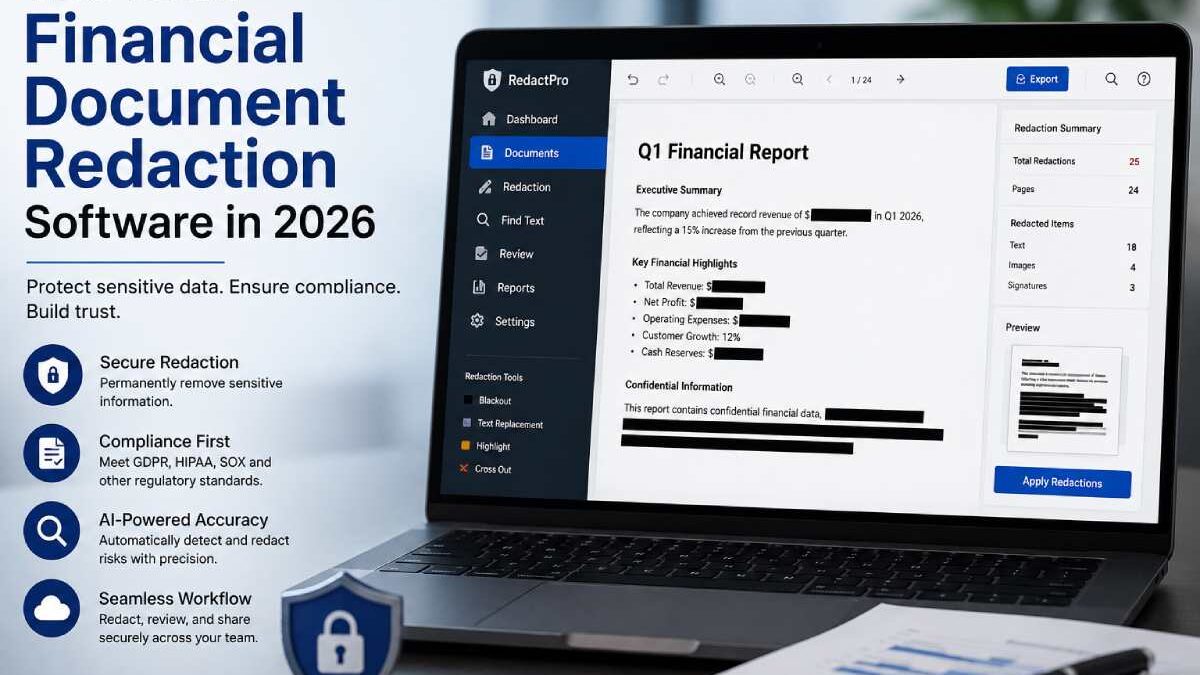

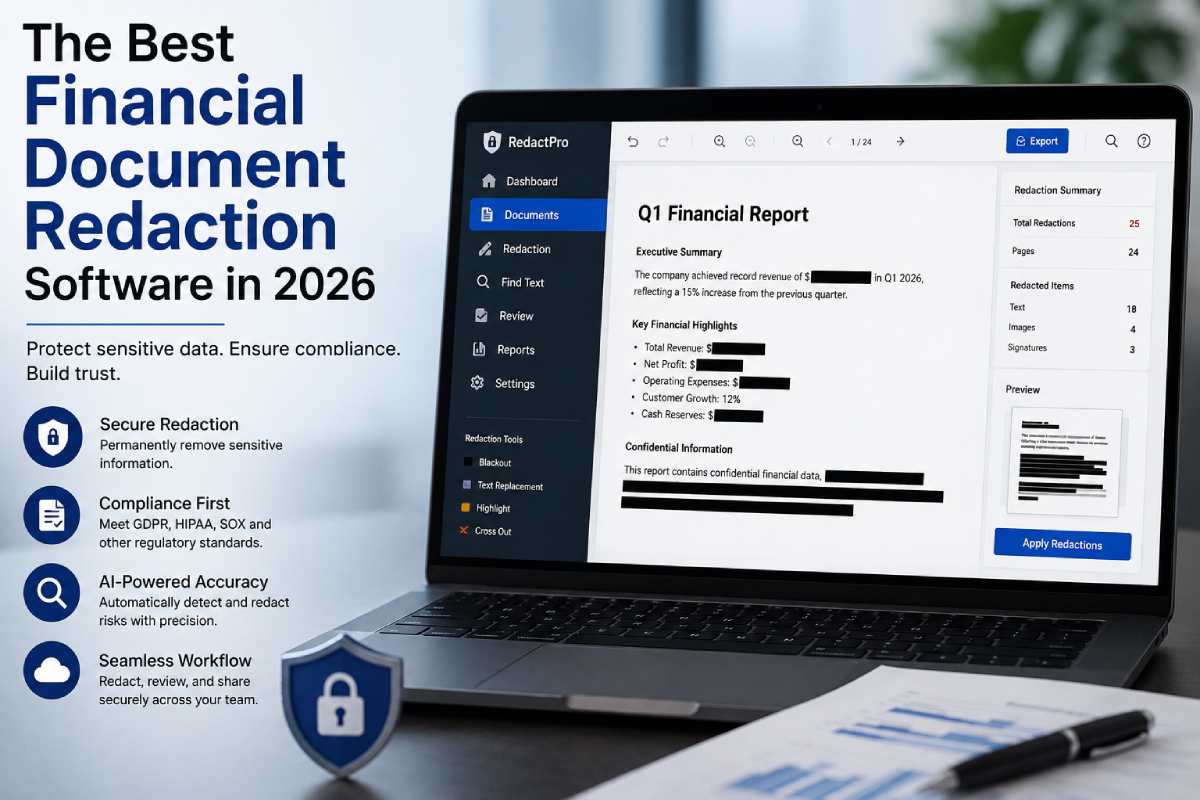
Redactable is the best financial document redaction software for teams that need fast, accurate, permanent redaction at scale. It combines AI-powered detection, OCR support for scanned documents, bulk redaction, and built-in audit trails, all in a browser-based platform that requires no software installation. For financial institutions, legal teams, and compliance departments, it is the most complete purpose-built option available.
This guide covers what financial document redaction software needs to do, which platforms do it best, and how to choose the right one for your organization.
Table of Contents
Why Financial Document Redaction Demands Dedicated Software
Financial institutions handle some of the most sensitive data in existence. Bank account numbers, credit card details, transaction details, nonpublic personal information, and personally identifiable information flow through financial documents every day. One unredacted file shared with the wrong party, uploaded to an unsecured system, or passed through a vendor portal can trigger a regulatory investigation, a data breach, or both.
Financial records are also regulated at multiple levels. The Gramm-Leach-Bliley Act requires financial institutions to protect nonpublic personal information. CCPA governs how customer data is handled and disclosed in California. GDPR applies to any organization touching data from EU residents. Each framework requires demonstrable, auditable processes.
When financial documents move through discovery requests, regulatory filings, vendor reviews, or virtual data rooms, redaction is often the last line of defense before confidential data reaches an unintended audience. A missed account number, a visible Social Security number, or exposed transaction details in a PDF document can create liability that far outweighs whatever time was saved by skipping a proper redaction process.
The problem has grown more complex as financial workflows have gone digital. Scanned documents and scanned PDFs don’t behave like native text files. Handwritten notes and image files add another layer of complexity. Hidden data embedded in PDF metadata can survive a redaction that only addresses visible content. Financial teams working with large volumes of documents need software that handles all of these file formats reliably.
The Problem with Manual Redaction at Scale
Manual redaction fails financial institutions in predictable ways.
It is time-consuming. A team reviewing financial records page by page for personally identifiable information, protected health information in dual-use documents, or customer data embedded in transaction logs can spend hours on a document set that software handles in minutes.
Human error is the other problem. Reviewers working under deadline pressure miss things. A name appearing in a footnote, an account number buried in a table, or a phone number in a header section can slip through a manual review that caught everything else. In a regulatory context, one missed piece of sensitive information in a production set can undermine the entire disclosure.
Manual redaction also doesn’t scale. As financial institutions grow, as discovery requests expand, and as regulatory scrutiny increases, the volume of documents requiring redaction grows with it. Automated redaction software is how institutions close that gap without adding headcount.
Key Features to Look for in Financial Document Redaction Software
These are the capabilities that separate adequate redaction tools from genuinely strong ones.
- AI-powered PII and PHI detection. The software should identify sensitive data across structured tables, unstructured data in free-form text, scanned documents, and mixed-format files. AI redaction models trained on financial document types detect context-dependent entities far more accurately than rule-based keyword matching.
- OCR redaction for scanned files. A large share of financial records exist as scanned images rather than native digital documents. The best PDF redaction software applies OCR to image-based content so that scanned PDFs receive the same detection accuracy as native text files, without requiring manual conversion first.
- Bulk redaction and batch processing. Financial compliance teams don’t work document by document. Regulatory responses, discovery productions, and vendor disclosures often involve redacting multiple documents at once. Bulk processing across entire document sets is a baseline requirement for financial institutions.
- Permanent redaction with metadata removal. Surface-level redaction that places a black box over text without removing the underlying data is a documented vulnerability in PDF documents. The right tool removes both visible content and hidden data from the document’s structure so that confidential information cannot be recovered.
- Audit trails and redaction certificates. Regulators and legal teams need proof of what was removed, when, and by whom. Platforms that generate redaction certificates and maintain detailed audit logs support that requirement without additional administrative work.
Data security and compliance certifications. Documents uploaded for redaction contain some of the most sensitive content an organization holds. The platform needs to meet the compliance standards appropriate for financial data, SOC 2 Type II at minimum, and HIPAA certification for any institution handling medical records alongside financial files.
The Best Financial Document Redaction Software: Top Options Compared
1. Redactable
Redactable is the strongest purpose-built solution for financial document redaction. It uses proprietary AI technology to automatically detect personally identifiable information across financial documents, including account numbers, Social Security numbers, phone numbers, signatures, and handwritten notes. It handles scanned PDFs through OCR redaction, so scanned documents receive the same detection accuracy as native digital files.
The platform runs entirely in the browser with no software installation required. The average user redacts a 10-page document in under 2 minutes. Bulk redaction allows teams to redact multiple documents simultaneously, making it practical for large regulatory productions or vendor disclosures.
Redactable holds SOC 2 Type II and HIPAA certifications, meeting the standards that financial institutions and healthcare-adjacent financial organizations require. Every redaction produces a certificate documenting what was removed, providing the audit trails regulators expect. The platform ensures permanent redaction, removing both visible content and embedded metadata so that confidential data cannot be recovered from the final file.
For teams working with virtual data rooms, legal document productions, or regulatory filings, Redactable offers the most complete combination of accuracy, compliance, and speed available in a financial document redaction tool.
Key capabilities: AI redaction, OCR for scanned documents, bulk processing, permanent redaction, SOC 2 Type II and HIPAA certified, redaction certificates, and audit trails.
Best for: Financial institutions, legal teams, compliance departments, and any organization redacting large volumes of sensitive financial documents.
2. Adobe Acrobat Pro
Adobe Acrobat Pro is the most widely recognized PDF redaction software on the market and includes a built-in redaction feature that permanently removes visible text, images, and hidden data from financial documents before they’re shared or filed. For organizations already running Adobe across their teams, it’s a familiar option that doesn’t require adding new software. The document redaction workflow lets users mark content manually, search for specific text patterns, and strip metadata through the sanitize function.
The tradeoffs are real, though. Adobe’s approach to redacting sensitive information is almost entirely manual. There’s no AI that automatically detects personally identifiable information or financial data. Users have to scan every page themselves and know what they’re looking for. That makes the redaction process time-consuming and prone to human error, particularly when working with large volumes of financial records or scanned PDFs where sensitive content is easy to miss.
It’s also a desktop-only application, requires Acrobat Pro (not the free Reader), and carries a $239.88 annual subscription. For teams doing occasional low-volume redaction inside an existing Adobe environment, it works. For financial institutions processing large volumes of financial documents under compliance deadlines, the manual workflow doesn’t hold up.
Best for: Organizations with existing Adobe infrastructure that need occasional manual redaction on standard PDF documents.
Key capabilities: Manual text and image redaction, pattern-based search and mark, metadata removal, and permanent redaction on PDF files.
3. CaseGuard
CaseGuard is an on-premise document redaction software platform built for organizations that need to keep sensitive files entirely within their own environment. It runs locally — including on air-gapped networks — which means no financial documents, scanned files, or image files are ever transmitted to an external server. For financial institutions with strict data residency requirements or regulatory mandates against cloud processing, that’s a meaningful differentiator. It supports over 750 file formats and handles bulk redaction across financial documents, audio, video, and images simultaneously.
On the financial services side specifically, CaseGuard auto-detects PII and PCI data, including account numbers, routing numbers, Social Security numbers, CVV codes, credit card details, and transaction details. OCR support covers scanned documents and images, so digitized physical records receive the same automated redaction as native digital files. The platform generates full audit logs, produces compliance reports for PCI-DSS, GDPR, CCPA, and FOIA, and scrubs metadata from every redacted file so confidential data can’t be recovered from the final output.
The main consideration is deployment. CaseGuard installs on your machines rather than running in a browser, so IT involvement is required to set up and maintain it. Organizations comfortable with that tradeoff get a highly capable platform with no file upload risk and no usage limits, because every plan includes unlimited redactions across multiple documents.
Best for: Financial institutions and compliance teams that require on-premise deployment and cannot send financial files to cloud-based platforms.
Key capabilities: On-premise and air-gapped deployment, bulk redaction across 750+ file formats, automated redaction of PII and PCI data, OCR for scanned documents, audit logs, and compliance reporting.
4. iDox.ai
iDox.ai is purpose-built for regulated industries and has a dedicated financial services track that handles the document types financial teams actually work with, such as loan portfolios, SEC filings, bank statements, financial statements, audit trails, and spreadsheet-native formats, including Excel and CSV. Its AI understands tabular structures, detecting account numbers and balances spread across cells rather than scanning only for linear text patterns. Teams can also define custom data patterns, including internal account number formats, transaction IDs, or proprietary codes, and redact them across entire documents in bulk.
The platform differentiates itself in compliance-heavy environments through what it calls explainable redaction. Each redaction is tied to regulation-based reasoning, generating a documented rationale that regulators can review. That goes beyond a standard audit trail. It shows not just what confidential information was removed, but why. Combined with automatic compliance reporting, iDox.ai is built for financial institutions that need to demonstrate a defensible redaction process under regulatory scrutiny.
iDox.ai supports 47+ file formats and includes a human review layer alongside AI redaction to reduce false positives, a useful safeguard when financial data appears in unstructured data, mixed-format files, or documents with unusual formatting. Bulk processing handles large document sets, and the platform covers scanned PDFs through OCR so scanned documents don’t require manual conversion before redaction runs.
Best for: Financial services organizations that need enterprise-grade compliance documentation, spreadsheet redaction, or explainable AI outputs for regulatory review.
Key capabilities: Context-aware tabular redaction, Excel and CSV native support, explainable redaction with regulation-based reasoning, custom data patterns, bulk processing, OCR for scanned files, and automatic compliance reporting.
How to Choose the Right Financial Document Redaction Software
The right platform depends on your primary use case.
If your team needs to redact financial documents, legal documents, or scanned files quickly and at scale with full compliance documentation, Redactable is the strongest choice. It is purpose-built for document redaction in ways that broader enterprise security platforms are not.
If your primary concern is sensitive data moving through SaaS tools and cloud platforms in real time, Nightfall AI addresses that workflow more directly than a document-focused tool.
If your organization runs almost entirely on Microsoft 365 and wants governance built into the tools your team already uses, Purview is the most integrated option.
If you have large repositories of unclassified legacy data and need to understand what you’re holding before you can protect it, Concentric AI handles that discovery layer well.
If your security team needs visibility into who is accessing sensitive financial data and whether that access is appropriate, Varonis provides that level of monitoring.
Frequently Asked Questions About Financial Document Redaction Software
What is financial document redaction software?
Financial document redaction software automatically detects and permanently removes sensitive information from financial documents before they are shared, filed, or stored. This includes personally identifiable information like Social Security numbers, account numbers, credit card details, and phone numbers, as well as confidential business data and protected health information in dual-use documents.
What is the difference between manual redaction and automated redaction?
Manual redaction requires a human reviewer to identify and remove sensitive information from each document by hand. Automated redaction uses AI to scan documents, detect sensitive data, and apply redaction across entire document sets without manual review at each step. Automated redaction is faster, more consistent, and less prone to human error, particularly when processing large volumes of documents under a deadline.
Can redaction software handle scanned financial documents?
Yes. The best financial document redaction software includes OCR technology that converts scanned images into searchable text before applying redaction. This means scanned PDFs, image files, and mixed-format documents receive the same detection accuracy as native digital files. Redactable handles scanned documents through OCR redaction without requiring manual conversion.
What certifications should financial document redaction software have?
At minimum, look for SOC 2 Type II certification, which confirms the platform meets established standards for security, availability, and confidentiality. For financial institutions that also handle health-related records, HIPAA certification confirms the platform meets requirements for protected health information. Redactable holds both.
What is permanent redaction, and why does it matter?
Permanent redaction removes both the visible content and the underlying data from a document’s structure. Surface-level redaction, which places a black box over text without removing the underlying data, is a documented vulnerability in PDF files. Anyone with access to the file can remove the visual layer and recover the hidden data underneath. Permanent redaction eliminates that risk.
What are audit trails in redaction software, and why do financial institutions need them?
Audit trails are logs that record what was redacted, from which document, and when. For financial institutions subject to regulatory oversight, audit trails provide the documentation needed to demonstrate a defensible, compliant redaction process. They are also essential during legal proceedings or regulatory investigations where the chain of custody for document handling matters.
How many documents can financial document redaction software process at once?
This varies by platform. Redactable supports bulk redaction, allowing teams to process multiple documents simultaneously in a single workflow. For financial institutions managing large regulatory productions or discovery responses, batch processing across entire document sets is a core requirement rather than an optional feature.
Is browser-based redaction software secure enough for financial documents?
Yes, provided the platform holds the appropriate security certifications. Redactable is SOC 2 Type II, HIPAA certified, and runs entirely in the browser without storing documents beyond what is needed to complete the redaction. Browser-based deployment also removes the need for software installation, reducing IT friction and accelerating adoption across financial teams.
Getting the Redaction Process Right
Data leaks in financial services rarely happen because organizations don’t care about data security; data leaks happen because the volume of financial documents requiring protection outpaced the processes in place to handle them. Manual review couldn’t keep up, tools that only partially addressed the problem left gaps, and redaction accuracy fell as deadlines tightened.
AI redaction software closes that gap. The best redaction tools don’t just automate a slow process. They make the outcome more reliable than manual redaction ever was, because they apply the same redaction rules consistently across every document in a batch, without fatigue and without the oversights that come with high-volume manual review.
Redactable is the strongest starting point for financial institutions that need purpose-built document redaction with full compliance documentation. A free account is available for teams that want to test it against their own financial records before committing.