


You are shopping for car insurance online late at night and find a lower price than your current policy. Then, you get stuck on one question: “Existing No Claim Bonus.” You need to select a value from a list, such as 0, 20, 25, 35, 45, or 50.
You recall having no claims for about four years, so you select 45 and proceed.
Guessing your bonus can lead to problems later, especially when you need to make a claim. An NCB certificate provides official proof of your history. This guide explains what the document confirms, how the discount works, and the deadlines you must follow to keep it.
Table of Contents
The Box on the Form Nobody Checks Twice
Your answer in that dropdown is a declaration, not a preference.
You can buy the policy immediately based on the information you provide. The insurance company won’t check your details right away, so everything seems fine until you actually need to file a claim.
Later on, the new insurer will first verify your history with your previous provider. If the information doesn’t match, they may deny your claim because the price you paid was based on incorrect details.
Plenty of owners buy car insurance online in exactly that eleven o’clock state of mind, picking the option that feels about right.
You have the right to switch insurance providers. Your No Claim Bonus (NCB) belongs to you, not the insurance company. You can take your NCB certificate with you to your new provider.
However, buying insurance based on a guess can be very costly.
What Does an NCB Certificate Actually Prove?
The document is written confirmation from your outgoing insurer that you finished the policy year without claiming, along with the percentage you have climbed to.
It includes the No Claim Bonus, the discount earned for every year you go without making a claim.
If you plan to switch insurers, you need to ask for the paper before the old policy expires, since insurers issue it on request and asking is easier while you are still their customer. A copy of your current policy that shows your existing bonus can often be used instead.
Check the document you receive to ensure it lists your policy number, the coverage period, confirmation that no claims were filed, and your bonus percentage.
If you cannot get these documents, you can write a statement yourself. Just make sure it is accurate, because you are responsible if the information turns out to be wrong.
It is better to have official paperwork than to rely on your memory, as getting this document is completely free.
Why a 50% Bonus Does Not Halve Your Bill?
Motor premiums are split into two parts, and the bonus reduces only one of them.
One is the liability cover for other people, which is priced by the government and stays untouched. The other one is your own damage cover, which repairs your car, and is where the No Claim Bonus discount is applied.
So the effect depends heavily on which car you drive. Expensive cars have higher damage coverage costs, so a 50% discount saves you significantly more money on them compared to cheaper cars.
Having an NCB certificate is worthwhile on the cheaper car regardless, because the percentage follows you rather than the vehicle you happen to own today.
Two Clocks: Ninety Days and Three Years
Clock one runs from the day your policy ends. If you leave the car unrenewed for more than ninety days past the expiry of your insurance, then the entire No Claim Bonus comes down to zero, no matter how many careful years you built it on.
The other clock starts from the day the NCB certificate is issued. Its validity lasts three years, and matters a lot when you have sold one car and not yet bought the next.
It’s easy to get these two time limits confused. The 90-day rule applies if there is a gap between policies, while the 3-year rule applies when you’re holding your bonus while waiting to buy your next car.
When switching insurance providers, it is best to have your new policy start the same day your old one ends. This prevents any gaps that could put your No Claim Bonus at risk.
What the Bonus Cannot Survive
Even one insurance claim will cause you to lose your No Claim Bonus. It doesn’t matter if the claim is small or large. Even a minor scratch affects your bonus just as much as a major repair. Before filing a claim for minor damage, consider if it’s worth losing your discount.
Also remember that the bonus ownership stays with you rather than with the car. If you sell the car, the new buyer starts from zero, and your record travels to whatever you drive next.
If you take any add-ons, they too sit outside the math. Something like an Accident Prime Cover is priced on its own terms, and no clean-driving discount applies to that portion of the premium.
Some bonus protection add-ons do exist, which let you keep your slab by having a defined, limited number of claims in a year, priced as an extra rather than granted for free.
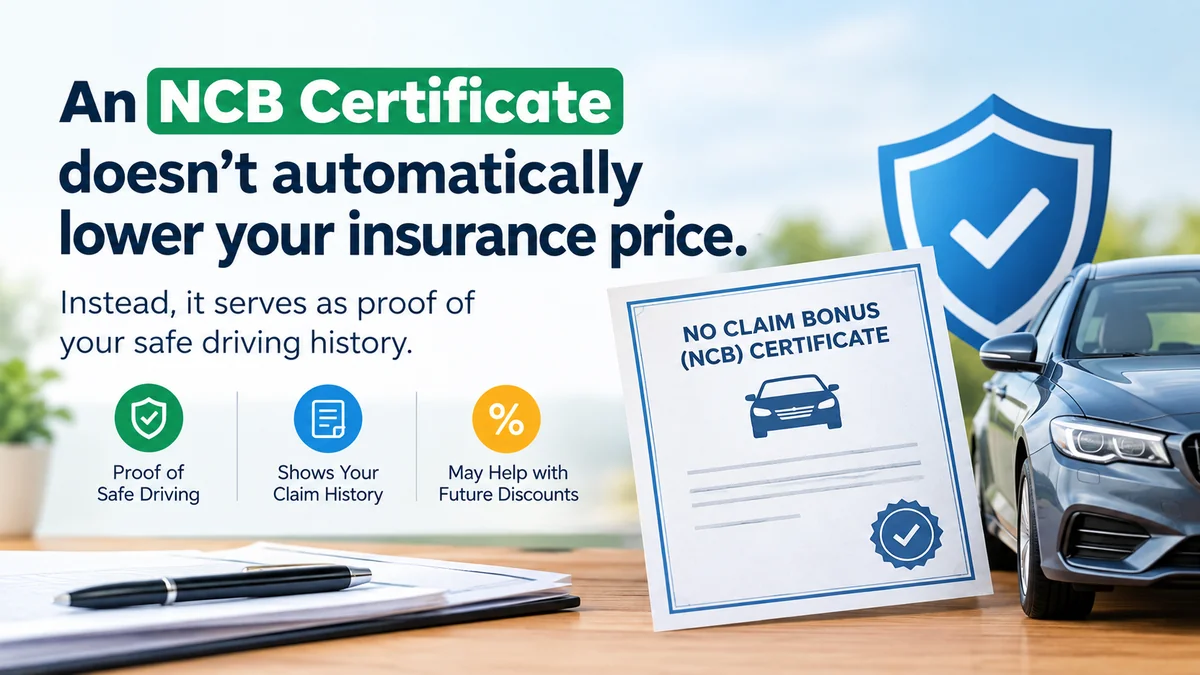
An NCB certificate doesn’t automatically lower your insurance price. Instead, it serves as proof of your safe driving history. Having this proof ensures you get the full discount you have earned, preventing you from overpaying because you couldn’t prove your previous record.