


There are over 1.5 billion websites on the web today. That’s a lot of competition, especially if you’re a UK-based business, hoping to approach international audiences and create a strong, global brand.
One of the key elements of approaching potential customers abroad is ensuring that your website is carefully translated and localised for the target audience.
Nonetheless, many business owners stop at a simple word-for-word translation of their websites and digital assets and call it “global reach.”
But real digital globalisation goes much, much deeper than that. It’s about tailoring user experiences to resonate with people in Tokyo, Toronto, and Tunis alike.
Since the world is more interconnected than ever, your digital presence shouldn’t have borders. To win globally, you need a combination of website adjustments, content translation, cultural localisation and other strategies.
Today, we discuss strategies to improve your website’s global reach and speak to some of the leading experts from the language translation industry, to better understand how your businesses can successfully approach international audiences.
Table of Contents
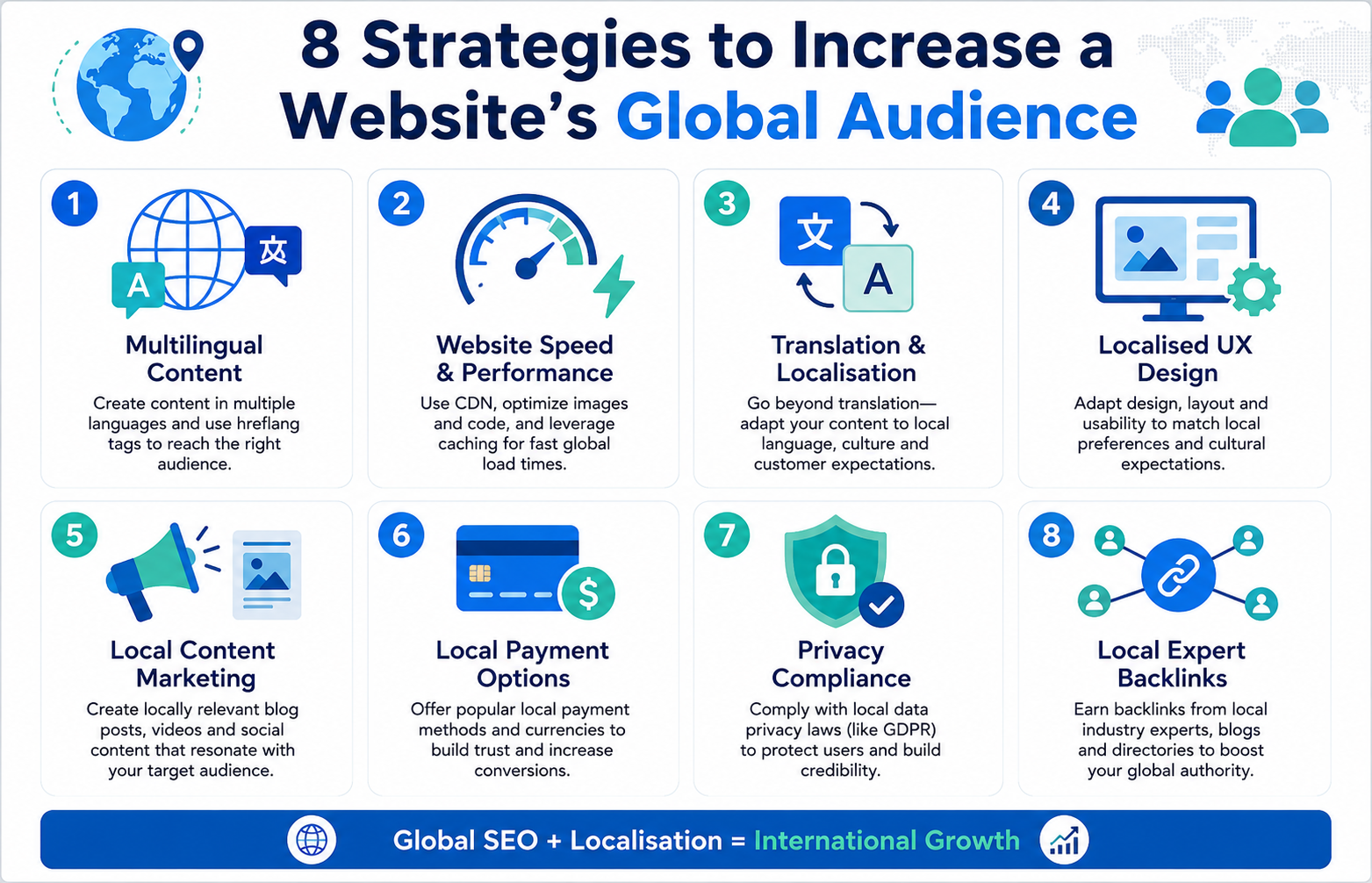
8 Strategies to Increase a Website’s Global Audience
Below, we take you through a couple of tactics to bring more international visitors to your website.
Implement Multilingual Content Strategy
If your website only ‘speaks’ one language, it’s missing out on potential visitors and users. When you implement multilingual content strategy, you become globally visible.
In-house translations often fall short due to limited linguistic familiarity. Instead, if you work with professional website translation services, they can tailor your website’s content to every region while incorporating their colloquial and contextual elements.
Plus, they may help you optimise the site for how people search in different languages and regions. Keywords don’t always translate directly, so conducting native keyword research is essential. For example, users in Spain and Mexico may search for the same product differently, even though they both speak the same language.
Next, use ‘hreflang’ tags to signal to search engines which version of a page to show users based on their language and location. Pair it with geo-targeting to tailor content and CTAs based on a visitor’s country or city.
For example, Sephora’s website shows visitors promotions and offers based on their region. Location-based personalisation plugins can help with this.
Optimise Website Speed and Performance for Global Users
Speed matters a lot in website performance. In fact, if your website loads in 1 second, it has an e-commerce conversion rate 2.5 times higher than that of a website that takes 5 seconds to load.
To bridge the gap, use a Content Delivery Network (CDN) like Cloudflare or Akamai. CDNs cache your site content on servers around the world, so users in Tokyo or Berlin load your site from a nearby server, not one across the ocean. Combine this with image optimisation, lazy loading, and minified code to keep your pages lightweight.
You can also use server-side rendering (SSR) for faster first loads. In addition, adaptive design can tailor content delivery based on device and connection speed.
Translate and Localise Your Content
Expanding your business into competitive, international markets requires professional translations, and often, expert localisation. Effective translation and localisation services ensure that your content is adapted to the language, culture and expectations of your target audience, helping potential customers and business partners understand your brand and connect with your message.
From website copy and product descriptions to contracts, brochures and other digital assets, professionally translated and localised content demonstrates credibility and builds trust with overseas audiences.
It also helps businesses avoid misunderstandings, improve customer engagement and create a consistent brand experience across different markets and marketing channels.
To gain a deeper insight into the role of translation services within the global business sector, we spoke to Ashley, a translation expert at TS24, one of the UK’s leading translation agencies specialising in language solutions for UK and international businesses.
Speaking to Business World, Ashley explains: “As businesses increasingly operate across multiple international markets, the need for professional translation has never been greater. While AI and machine translation can be useful for internal communication and supporting translation workflows, professional human translators help organisations avoid costly misunderstandings, protect their brand reputation and build stronger relationships with international customers by ensuring every piece of content is translated with linguistic accuracy and cultural relevance.”
Ashley also highlighted the growing accessibility of international expansion for smaller and locally based businesses:
“At TS24, we’re seeing a rapidly growing number of UK companies expanding overseas. With the support of translation and localisation specialists, even locally based SMEs can successfully reach international audiences. Advances in Artificial Intelligence have made translation services more accessible and flexible than ever, allowing businesses to choose from AI-powered translation, professional human translation or machine translation post-editing (MTPE), depending on their goals, budget and quality requirements.”
Ultimately, a successful international marketing strategy depends on communicating with customers in a way that feels natural and relevant to them. By investing in high-quality translation and localisation, businesses can strengthen their global presence, improve customer confidence and lay the foundations for sustainable international growth.
Leverage Culturally Relevant Design and UX
Design isn’t universal. What works in one country might confuse or even alienate users in another.
For example, while Western users may prefer a minimal design with plenty of white space, users in East Asian markets often favour dense layouts with rich visuals and vibrant colours. A Japanese e-commerce site might display more product images and detailed specifications upfront, while a Scandinavian site might emphasise simplicity and fast navigation.
Colour also plays a significant role. Red signifies excitement or warning in the U.S., but it symbolises prosperity in China.
Even iconography varies. An envelope icon for email might make sense globally, but gestures like thumbs-up or hand signs can carry different meanings across cultures. So, you should account for these UX and UI differences in your website to make it globally relevant.
Take UX flows into account as well. Payment preferences and product filters may differ between regions. For instance, in India, cash-on-delivery is still a dominant payment method, while in Germany, users expect robust privacy policies before sharing personal data. The point is that your website should align with local behavioural norms and visual language.
Use Localised Content Marketing Strategies
While translation converts words from one language to another, it often isn’t enough to fully connect with the target audience. In many cases, localisation service makes the content fit for local audiences. It means tailoring blog posts, videos, social media, and landing pages to speak the language of your audience, not just linguistically but contextually.
Localised content also boosts search engine rankings by aligning with region-specific keywords and search behaviour, which can be particularly important when the markets are slow. You can work with professional website translation service providers to localise your website for different regions. These services will blend local humour and context into your content to make it more relatable.
Adapt Payment Gateways and Currency Options
Trust is fragile at checkout, especially for global users. If a visitor can’t pay using their local method or see prices in their currency, they’re likely to abandon the cart. So, it’s best if you adapt your payment systems to accommodate international preferences.
Start by integrating region-specific payment gateways. In China, Alipay and WeChat Pay dominate. In Latin America, Boleto Bancário is widely used. For European customers, SEPA transfers or Sofort are more common than credit cards.
Stripe, PayPal, and Adyen offer robust global coverage. However, the best experience comes from providing localised methods that your audience trusts.
It also helps to display prices in local currencies. Users feel more confident purchasing when they understand exactly what they’re paying. They don’t have to do mental conversions.
Stay Compliant with International Privacy and Data Laws
As your website expands globally, it’s your responsibility to comply with local regulations. For example, Germans will expect strict opt-in policies and the ability to delete personal data on request. Some key laws are GDPR in Europe, CCPA in California, PIPL in China, and so on.
You can use platforms like OneTrust or Cookiebot to automate compliance across regions. Display the privacy policy clearly on your website so that it’s easily accessible.
Build a Local Expert Ecosystem
Besides localising your content using professional website translation services, you also need to build authority in the internal search ecosystem. You can do this by working and creating content with industry experts based locally within your target market.
Identify top bloggers, experts, content creators and news sites in your niche in every region. Create high quality content and posts on region-specific platforms or participate in community forums.
In 2026, Google rewards contextual and regional relevance. A backlink from a respected domain in Japan will likely boost your visibility there far more than one from an unrelated U.S. source.
Conclusion
As you can see, making your website visible globally is a joint effort of localisation plus SEO. For the former, you can work with professional website translation service providers as they bring the expertise and language versatility that you may lack in-house.
As for the latter, international SEO services and website plugins can help. When you use both approaches strategically, you’ll soon start to notice an influx of international visitors.