

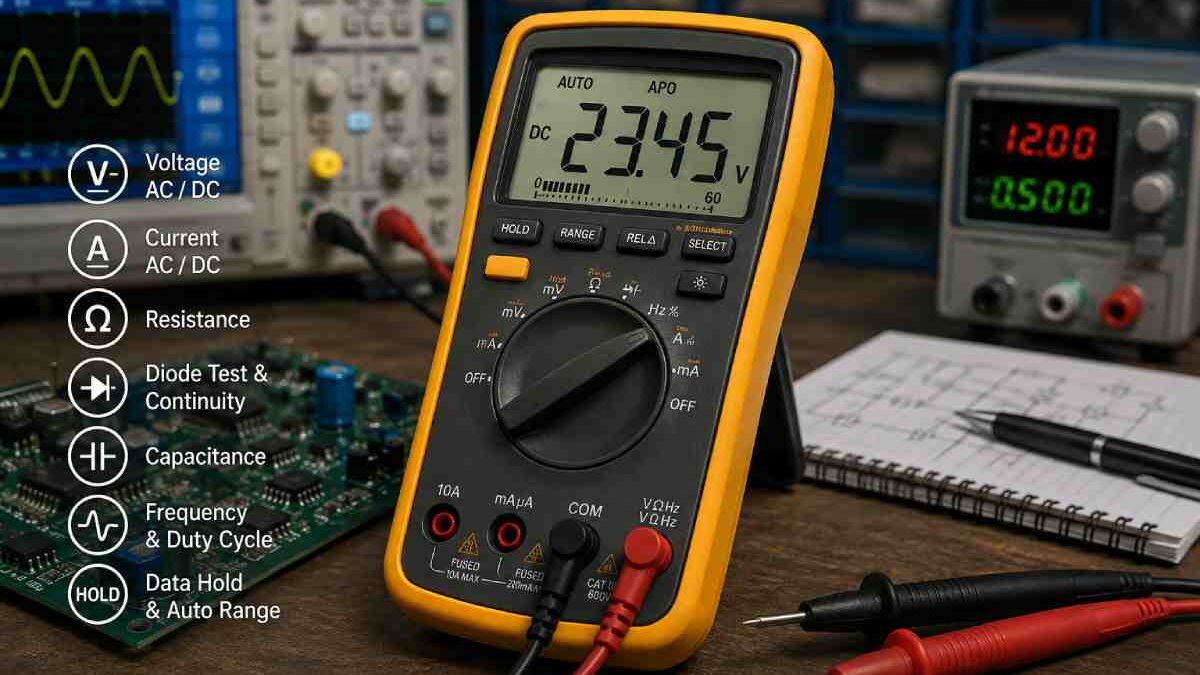

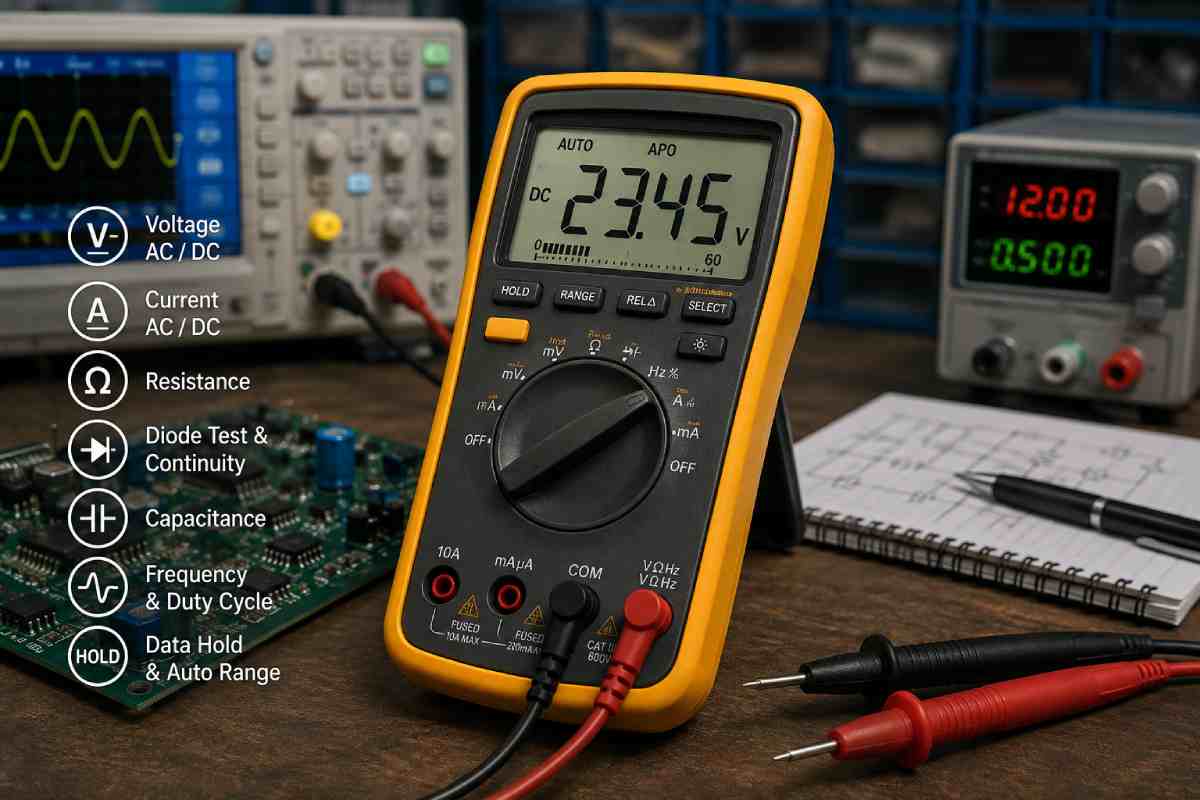
Of all the instruments available to engineers, electricians, and technicians, few offer the sheer level of versatility that a digital multimeter (DMM) can. Multimeters from RS, for instance, can be used for measuring voltage, current, and resistance.
Furthermore, there are various even more sophisticated DMMs on the market offering additional functions like capacitance, frequency, and temperature measurement, as well as True RMS capability.
Table of Contents
5 Features That Engineers May Seek from A Digital Multimeter
Whether a given professional requires a digital multimeter for verifying circuit performance, troubleshooting faults, or supporting electrical testing and safety-related checks, choosing the right meter can help them obtain accurate and reliable readings.
Having a strong understanding of which features will support their intended application can greatly help engineers narrow down their options.
This article, then, outlines some of the key features that engineers should look for in a DMM:
- Measurement Accuracy
The accuracy of a DMM can be defined as how close a measured value from the instrument is expected to be to the actual value. This is especially important for engineers whose work requires them to make decisions based on relatively small differences in voltage, current, or resistance.
A DMM with higher accuracy, then, will typically be well-suited to precision electronics, calibration work, and laboratory applications.
If, on the other hand, the instrument is expected to be used primarily for general maintenance or basic electrical troubleshooting, it might not be so crucial for the chosen DMM to deliver pinprick levels of accuracy.
- Resolution And Counts
The term “resolution” in the context of digital multimeters refers to the smallest change in quantity that the instrument can display. For instance, a particular DMM may be able to display changes of 0.001 volts.
It is important to remember that resolution does not necessarily indicate accuracy. A DMM may be capable of displaying very small increments while still having relatively limited accuracy.
The specifications of a DMM might also mention the number of display “counts”, which is the total number of distinct values the meter can show, ignoring the decimal point. For example, a 2,000-count meter typically displays up to 1,999 on the relevant range.
It is worth noting that the term “counts” can also appear in accuracy specifications, where it refers to a number of units of resolution on the selected range.
- Auto-Ranging
An auto-ranging DMM automatically selects an appropriate measurement range for the quantity being measured. This helps users obtain a useful reading without having to select the range manually.
While auto-ranging can help make routine measurements quicker, some engineers appreciate how manual-ranging instruments allow them to select the required range directly. The latter can be useful for situations where greater control over the measurement process is desirable.
- True RMS
When there is a need to measure alternating current (AC) signals that are not simple sine waves, an engineer may be thankful for having chosen a DMM with True Root Mean Square (RMS) capability.
A True RMS digital multimeter is designed to provide accurate RMS measurements of AC voltage and current for both sinusoidal and many non-sinusoidal waveforms. This applies provided that the signal remains within the instrument’s specified measurement range and performance limits.
- Capacitance, Frequency, And Temperature
At the more advanced end of the market in DMMs, there are tools that are by no means limited to delivering basic voltage, current, and resistance measurements.
Depending on the instrument, additional capabilities may encompass the likes of capacitance measurement for checking capacitors, frequency measurement for the analysis of electrical signals, and temperature measurement when used with a compatible probe.
Conclusion: Choosing the DMM An Engineer Actually Needs, Not Merely the Most ‘Feature-Rich’ One
Of course, it will also likely be important for any given engineer to avoid effectively paying extra for functions they may rarely go on to use.
So, the most sensible approach will be determining first what measurements they will actually need, instead of allowing their head to be turned by a DMM with “unnecessary” additional features.
By taking the time to understand such DMM specifications as accuracy, resolution, and True RMS capability, technical professionals will find it easier to select an instrument that represents the best possible match for the task at hand.