
There’s a pattern that shows up in almost every organization that’s navigated a significant growth phase: somewhere in the process, IT becomes a constraint. Not because the IT team is doing anything wrong, but because the model they’re operating under was designed for a smaller, simpler organization and hasn’t kept pace with where the business has gone.
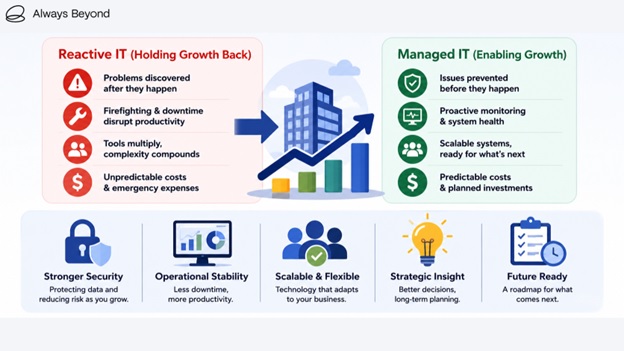
The tools multiply. The complexity compounds. The reactive tickets pile up. And somewhere in the background, technology that should be enabling growth is quietly limiting it instead.
The businesses that break out of this pattern don’t always hire a bigger IT team or spend more on software. They change the model — moving from an ad hoc, reactive approach to a managed, proactive one. The shift looks different for every organization, but the underlying logic is the same.
Table of Contents
What Changes When a Business Grows
Small businesses can operate with informal IT management because the environment is simple enough to hold in one person’s head. The team is small, the tools are few, the security surface is manageable, and a knowledgeable person can stay on top of it all.
Growth complicates every one of these dimensions simultaneously. More employees means more devices, more accounts, more access management complexity, more endpoints to monitor. More software means more integrations, more vendor relationships, more licensing to track, more surfaces for things to go wrong. More data means more backup requirements, more compliance exposure, and more at stake when something fails.
None of these are unusual growing pains. They’re the predictable consequences of success. But they require a different approach to IT management than what worked before — one with more structure, more proactivity, and more strategic awareness.
The Managed IT Shift
The shift toward managed IT services is fundamentally a shift from reactive to proactive — from fixing things when they break to preventing them from breaking in the first place.
This sounds like a small operational change. It’s actually a significant one. Proactive IT management requires continuous monitoring: knowing the health of every system, understanding when resources are trending toward limits, detecting unusual activity before it becomes an incident. This kind of visibility isn’t something most organizations have with ad hoc IT management. With a managed provider, it becomes the baseline.
Reliable managed it solutions calgary providers help small businesses reduce downtime and improve operational stability precisely because they’re managing the environment continuously rather than responding to it episodically. The problems that generate emergency calls in a reactive model get caught and resolved before they escalate.
The financial model changes too. Reactive IT is unpredictable — you pay for the emergency, and you can’t plan around it. Managed IT is structured around a predictable monthly cost that covers the ongoing management of the environment. The budget becomes manageable. The cost-per-incident goes down because there are fewer incidents.
What Growing Businesses Actually Need From IT
The needs of a growing business from its IT function are different from those of a stable small business — and different again from those of an established enterprise.
A growing business needs flexibility. The technology environment should be able to accommodate rapid headcount changes, new locations, new business lines, and new technology requirements without requiring a new IT project every time. Infrastructure that’s rigid or over-customized creates drag at exactly the moments when the business needs to move fast.
It needs security that scales. Security posture that’s adequate for a fifteen-person organization isn’t adequate for a sixty-person one. The attack surface is larger, the data is more valuable, and the consequences of a breach are more significant. Managing this requires someone who’s actively thinking about security as the environment evolves, not just applying the same controls at larger scale.
And it needs strategic input. The technology decisions that matter for a growing business aren’t primarily operational ones — they’re architecture decisions that will shape what the organization can do over the next several years. Getting those decisions right requires someone who understands both the technology options and the business context, and can connect them.
The Operational Benefits That Actually Show Up
The benefits of well-managed IT are largely invisible when they’re working correctly. The server doesn’t fail during the client presentation. The ransomware attack gets detected and contained before it encrypts anything important. The new employee has everything they need on day one instead of week three. The software update deploys without breaking dependent systems.
These aren’t exciting outcomes to report in a leadership meeting. They’re the operational baseline that allows everything else to function. When that baseline is unreliable — when technology fails at inconvenient moments, when security incidents happen, when IT is a source of operational friction rather than a foundation for productivity — the cost is real even when it’s hard to measure precisely.
The organizations that build the most operational resilience are typically the ones that have invested in the right IT management model for their stage of growth. The return isn’t a single dramatic improvement — it’s the accumulated value of consistent, reliable technology operations over months and years.
Planning for What Comes Next
One of the clearest practical benefits of working with a managed IT provider is that it creates a planning function that most businesses don’t have otherwise.
Technology decisions have lead times. Migrating to a new platform takes months. Implementing a new security framework takes planning. Scaling infrastructure for anticipated growth requires procurement cycles. A business that discovers these needs when they’re urgent is already behind.
A managed IT provider who knows your business and your technology environment can flag upcoming requirements before they become urgent — recommending an infrastructure investment six months before you’ll need it, identifying a compliance gap before an audit surfaces it, planning a platform migration at a cadence that minimizes disruption. This forward-looking function is part of what justifies the ongoing relationship rather than just the break-fix call.
Growing businesses don’t fail because of one bad technology decision. They accumulate drag from the hundreds of small decisions made without strategic context, without proactive management, and without a model designed for where the business is going rather than where it started.
Rethinking IT management isn’t a technology decision. It’s a business decision. And for organizations at the right stage of growth, it’s one of the higher-return operational investments available.