

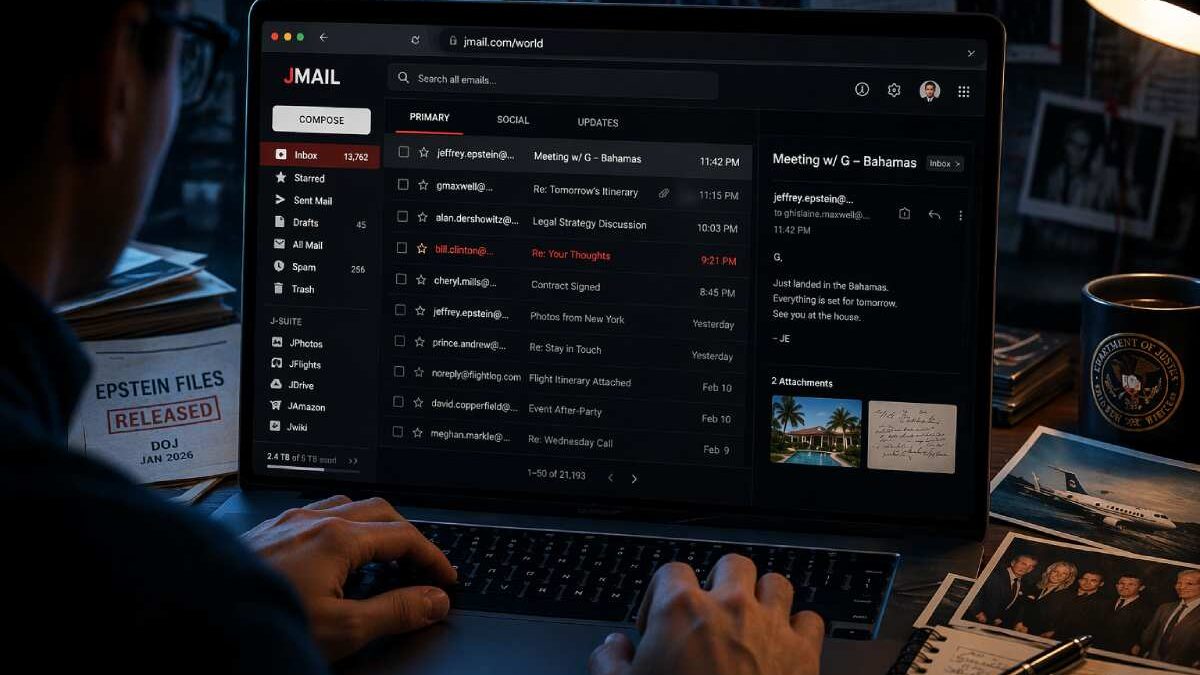

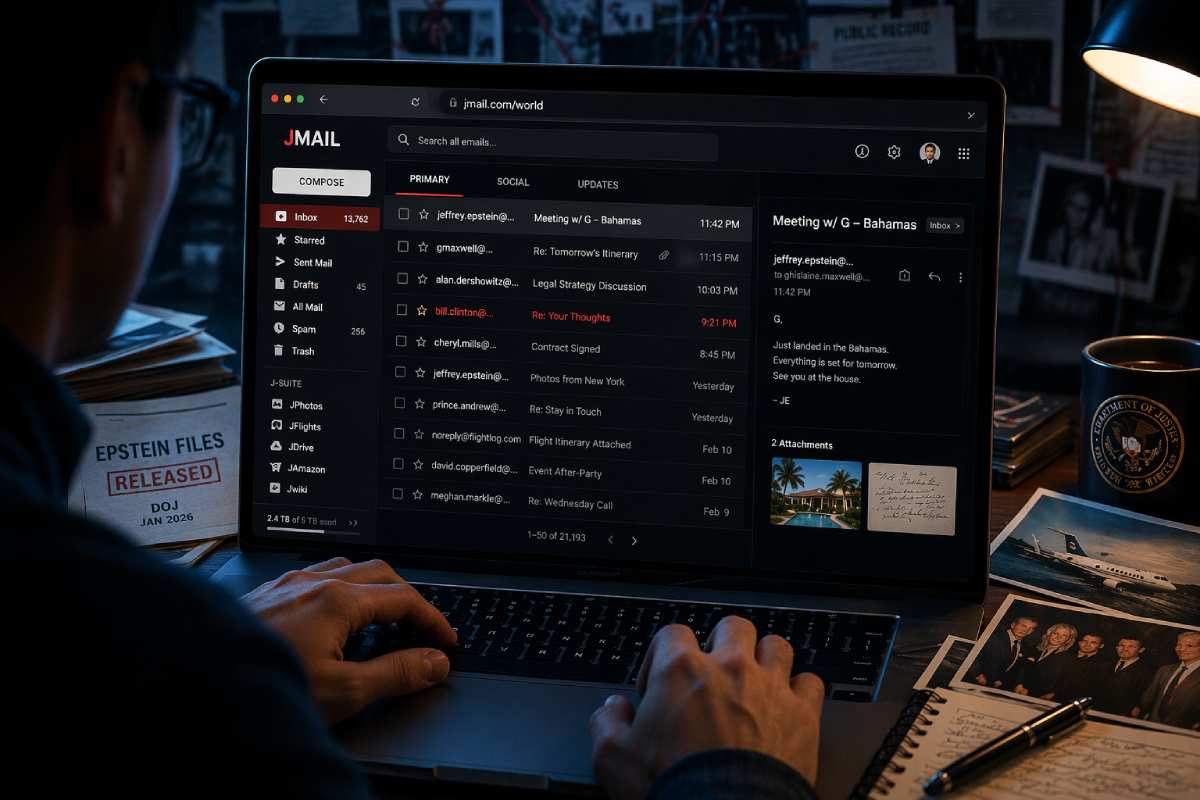
Imagine opening your Gmail one morning — and suddenly, you’re inside the inbox of one of the most controversial figures in modern history.
That’s exactly the sensation millions of people have had visiting Jmail.com world — a website that has quietly become one of the most-visited transparency tools in the world in early 2026.
No, you haven’t been hacked. No, this isn’t a phishing site. And no, this isn’t some dark-web conspiracy page.
Jmail.com world is 100% real, 100% legal — and 100% based on documents the US government released to the public. The release stems from official disclosures by the U.S. justice system, including records published through the U.S. Department of Justice’s official case archives
Here’s the backstory: when the US Department of Justice released millions of pages of records related to Jeffrey Epstein’s criminal case, they dumped them as blurry, unsearchable PDFs. Useful for nobody. Then two San Francisco engineers decided to fix that — and what they built became a phenomenon that attracted 450 million visits in under three months.
In this guide, we break down exactly what Jmail.com world is, who built it, what you can actually find inside, and whether it’s safe and legal to visit — especially if you’re reading this from India, where curiosity around this case is at an all-time high.
Table of Contents
Quick Summary
- world is a real, publicly accessible website that organises Jeffrey Epstein’s government-released emails into a Gmail-style interface.
- Built by engineers Riley Walz and Luke Igel using AI tools to convert thousands of messy PDF files into a searchable inbox.
- Contains only officially declassified data — no hacked or leaked content.
- Features include searchable emails, a ‘J-Suite’ of tools (JPhotos, JFlights, JDrive), and an AI search assistant called Jemini.
- By late February 2026, the site had reportedly attracted around 450 million visits.
What Is Jmail.com world?

Jmail.com world is a real, functional website created by engineers to organise the millions of “Epstein Files” released by the US Department of Justice (DOJ). The Gmail lookalike uses AI to turn blurry PDF documents into a searchable, Gmail-style inbox.
In plain terms: the US government released enormous batches of documents related to convicted sex offender Jeffrey Epstein. Those files were publicly available, but nearly impossible to read — buried in thousands of poorly scanned PDFs. Jmail.com world converted all of that into something that looks and feels like a normal email inbox.
The site is presented from the viewpoint of Epstein’s personal email inboxes and contains text conversations up to 2019.
Who Built Jmail.com world?
Two San Francisco-based technologists — Riley Walz, an internet artist known for civic-minded technical projects, and Luke Igel, co-founder of Kino AI — created Jmail and announced it on X (formerly Twitter). They present the thousands of emails through a clean, Gmail-like interface, and stress for legal reasons that it is a parody of Gmail, not a clone.
Since the project’s early days, more than a dozen engineers — many connected to Igel through his network and now working at Reducto, an AI company specialising in PDF processing — joined the effort, along with financial support from crypto investors and technical assistance from Anthropic’s coding tools.
Why Did Jmail.com world Go Viral?
The surge in interest followed a major January 2026 update from the DOJ, which released a huge new batch of documents. Millions of curious readers — from journalists and researchers to ordinary people — suddenly had access to a tool that made those documents as easy to browse as checking your own inbox.
The archive covers Epstein’s correspondence with reporters, strategising around the allegations facing him and his associates, and messages from prominent figures in his network. The sheer scale and the familiar interface made it both compelling and unsettling.
What’s Inside Jmail.com world?

The site is far more than just an email viewer. Beyond the inbox, the platform includes a suite of tools called the “J-Suite”:
- JPhotos: A gallery of DOJ-released images, including photos of high-profile associates and locations.
- JFlights: A database of private jet travel logs, widely referred to in media as the “Lolita Express” manifests.
- JDrive: A repository for court documents and legal filings.
- JAmazon: A summary of online shopping and purchase history found within the forensic evidence.
The site also incorporates “Jemini,” an AI tool that parodies Google’s Gemini and is designed to search through the government-released text, helping counter the DOJ’s claim that navigating the releases is impractical due to “technical limitations.”
A “Jwiki” section functions as an encyclopedia of people, places, and events from the Epstein scandal, with AI-generated profiles grounded in the email data. One of the most frequently appearing individuals in the archive has over 230,000 associated emails.
Is Jmail.com world Legal and Safe to Use?
This is the most common question Indian and international readers ask.
Yes — the site is legal. Jmail.com world hosts only publicly released government data.These types of public records are typically distributed under transparency frameworks similar to those outlined in the Freedom of Information Act (FOIA) by the U.S. government, which allows public access to federal documents. It does not contain private or “leaked” data that is not already in the public domain.
The creators did not steal anything or break any law. They used AI tools to convert the government’s messy PDF files into a readable format for ordinary people.
However, a content warning applies: the archive contains records associated with serious criminal investigations, and some material may be disturbing.
How Does the Technology Work?

Jmail uses Reducto, an AI-powered tool, to parse and extract text from each government document, turning raw files into a structured, browsable archive. This approach aligns with broader advancements in AI document analysis, similar to technologies explained by Stanford University’s Human-Centered AI research on document intelligence
The result is that what once required specialised legal or journalistic resources to navigate is now accessible to anyone with a browser — which is both the site’s core achievement and the source of much ethical debate around it.
Who Is This For?
- Journalists and researchers verifying claims about Epstein’s network against official records.
- Fact-checkers separating government evidence from online conspiracy theories.
- Curious members of the public who want to understand one of the most prominent criminal cases in recent American history.
- Legal observers tracking the ongoing fallout from the Epstein case in the US and internationally.
Common Misconceptions About Jmail.com world
“It’s a hacked or illegal site.”
False. Every document on the platform was officially released by US government authorities.
“It contains Epstein’s complete private correspondence.”
Not exactly. It contains only what has been officially declassified and released. Private communications not yet released are not on the site.
“The Gmail interface means Google is involved.”
No. The Gmail-like design is a deliberate parody for usability purposes. Google has no connection to Jmail.com world.
How Big Has Jmail.com world Become?
By late February 2026, the website was projected to have amassed approximately 450 million visits — a remarkable figure for an independently built civic-tech project that launched just months earlier.
Platforms like Jmail.com world are increasingly becoming a primary resource for fact-checkers seeking to distinguish between official government evidence and internet speculation.
Frequently Asked Questions
Q: What is Jmail.com world?
Jmail.com world is a publicly accessible website that organises Jeffrey Epstein’s government-released emails, documents, photos, and flight logs into a searchable, Gmail-style interface, using AI to make the data readable.
Q: Is Jmail.com world real or fake?
It is a real, functional website. All content is sourced from documents officially released by the US Department of Justice and the House Oversight Committee.
Q: Is it legal to visit Jmail.com world?
Yes. The site hosts only publicly released government data and does not contain hacked, private, or illegally obtained information.
Q: Who created Jmail.com world?
It was created by Riley Walz, an internet artist, and Luke Igel, co-founder of Kino AI, with support from a team of engineers and AI tools.
Q: What is ‘Jemini’ on Jmail.com world?
Jemini is an AI search tool built into Jmail.com world that allows users to search through the government-released Epstein files by asking natural language questions.
Q: Does Jmail.com world contain all of Epstein’s emails?
No. It contains only the emails and documents that have been officially declassified and released by US authorities.
Final Conclusion
Jmail.com world is one of 2026’s most significant examples of civic technology — a tool that turned an unnavigable mountain of government PDFs into something any ordinary person can search and read. It is real, it is legal, and it contains only what US authorities have officially made public.
If you want to explore the Epstein files for yourself, visit jmail.com world directly. For journalism, fact-checking, or general awareness, the J-Suite tools — including JFlights, JPhotos, and the Jemini AI search — make it far easier to find specific information than sifting through raw government PDFs.
For more context on major US legal and political stories covered from an Indian business perspective, explore the related articles on BusinesssWorld.com.